Why I Organized Everything I Know About Scaling Organizations into Four Elements

BLUF/Summary
After two decades of building, advising, and investing in organizations, I've found that every scaling success or failure I've witnessed comes down to the relationship between four things: people, operating system, strategic clarity, and execution discipline. I call this the Keel Framework, and I recently rewrote the full explanation of it on this site. This post is the story behind the framework — why these four elements, why this order, and what I learned the hard way about what happens when you get one of them wrong.
You can read the complete Keel Framework here. But frameworks on a page don't explain themselves. They don't tell you why one element comes before another, or what happens when you skip one, or which mistake the author made three times before finally learning the lesson. So, before you read the framework, let me tell you how I arrived at it.
The Pattern
I started my career learning from several well run and a few poorly run programs at Lockheed Martin, and since then I was busy helping build an organization (Halfaker and Associations) from a startup to over 500 people, then advising and investing in dozens of companies across government contracting, technology, nonprofits, and early-stage ventures. The contexts vary wildly. The pattern doesn't.
The organizations that scale well all have the same four things working together. The ones that struggle are always missing at least one, and they usually don't realize which one until the pain is acute. A company with a brilliant strategy but no operating infrastructure to execute it. A company with great systems but a culture that undermines them. A company moving fast on execution but headed in the wrong direction because nobody paused to define where "there" is.
The Keel Framework is my attempt to name and sequence those four things so other leaders can see the pattern before the pain shows up.
Why People Come First
If you asked me early in my career what mattered most for scaling, I would have said technology/the product or business strategy. Get the thing or the direction right and everything else follows. I was wrong.
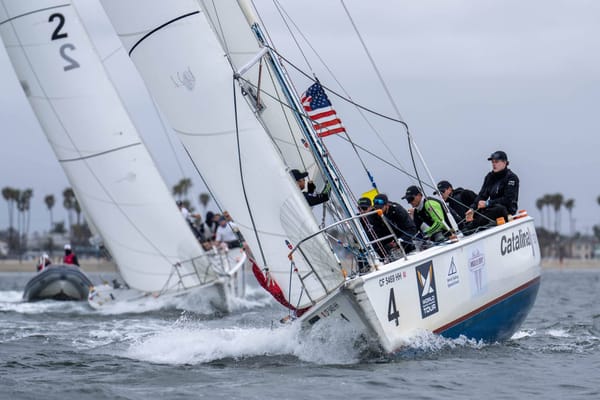
The first element of the framework is The Boat, which is composed of the people, culture, and leadership that form the vessel itself. I put it first because people and the culture that connects them can destroy a company so quickly. You can build the most elegant operating system in the world, but if your culture rewards blame-avoidance over ownership, people will work around it. You can set a bold strategic vision, but if your leaders model the opposite behavior, the vision is just words on a slide.
Culture isn't a poster. It's the set of operating norms that determine how people behave when the pressure is on and nobody is watching. Leadership isn't charisma. It's system design, creating an environment where ownership, accountability, and initiative are the path of least resistance. I've written about this in more detail in my post on why high agency is a systems problem, not a hiring problem, but the short version is: you don't get a high-performing crew by hoping you hired the right people. You get it by building a vessel where good people can do their best work.
The Boat comes first because everything else is built on top of it. A cracked hull can't hold a keel.
Why the Operating System Is the Keel, Not the Sail
This is the counterintuitive heart of the framework, and it's the lesson that took me the longest to learn.
When I started building organizational infrastructure at Halfaker: the documented roles and responsibilities, the operating cadences, the knowledge management systems, the accountability rhythms, the process libraries; they felt like overhead. Every hour spent documenting a process was an hour not spent delivering for clients. Every meeting added to the operating cadence felt like one more thing competing for people's time.
But something happened as the organization grew past 100, then 200, then 300 people. The companies around us that hadn't built this infrastructure started to struggle. New hires took months to become effective because nothing was written down. Decisions bottlenecked at senior leaders because nobody knew who had authority over what. Strategy disconnected from execution because there was no cadence connecting them. Compliance became a scramble because the "real" organization and the "documented" organization were two different things.
Meanwhile, our teams moved faster. A new hire could go to employee onboarding, read the operating manual, and know how we worked. A leader could check the roles matrix and know what they owned. A strategic goal could be traced from the annual plan down to this week's sprint. The documentation wasn't overhead. It was the keel.
That's the key insight: the Enterprise Operating System — roles, cadences, processes, knowledge management, accountability mechanisms — isn't the sail. It's not what makes you go fast. It's what lets you carry speed without tipping over. The heavier the keel, the more sail the organization can handle. And in the AI era, the wind has never been stronger.
I've explored what this means practically in my post on why AI agents are only as smart as your process assets. The short version: every AI capability your organization deploys depends on the documented, maintained institutional knowledge beneath it. Automation can only systematize processes that have been defined. Agents can only act on knowledge that's been captured. The keel is what makes the sail useful.
Why Vision Comes Third
Most leadership content puts vision first. Start with why. Begin with the end in mind. Define your North Star.
I don't disagree with any of that in principle. But in practice, I've watched too many leaders set a bold vision and then wonder why the organization couldn't execute it.
Vision in the Keel Framework comes third, not because it's less important, but because it's useless without the first two elements. A destination on the chart means nothing if the vessel is taking on water. A compass heading means nothing if the boat tips over the moment the wind picks up or if everyone is arguing about how to move forward.
But once the boat is sound and the keel is heavy? Vision becomes the most powerful force in the organization. When people have clarity on roles, when systems handle the operational load, when the operating cadence keeps everyone aligned — that's when strategic vision transforms from aspiration to navigation. People aren't just surviving the day-to-day anymore. They have the bandwidth to steer.
The other critical piece here is the connection between vision and execution. A strategy that lives in a PowerPoint from January and surfaces again in December is not a strategy. It's a hope. The Keel Framework insists on bidirectional traceability, the ability to trace any piece of tactical work up to the strategic objective it supports, and any strategic objective down to the tasks being executed this week. When that traceability exists, strategy isn't something leaders talk about. It's something the organization does.
Why Execution Is "Sail and Adjust," Not Just "Sail"
I named the fourth element "Sail and Adjust" for a reason. Execution isn't a one-time act. You don't hoist the sail, lock the tiller, and walk away. Real execution is continuous trimming — constant small adjustments in response to changing conditions.
In practice, this means progressive decomposition: long-term goals broken into annual objectives, broken into quarterly targets, broken into sprint-level tasks with clear owners and acceptance criteria. It means operational reviews that aren't status updates but actual decision-making forums. It means retrospectives that surface what's not working and process improvement cycles that fix it. It means leaders operating as product owners of their team's work — knowing the backlog, validating the priorities, grooming the next sprint — not just delegating and hoping.
The "Adjust" part is what separates organizations that execute from organizations that merely plan. Planning is necessary but not sufficient. The organizations that scale well are the ones that build feedback loops — strategy reviews, quality audits, sprint retrospectives, process improvement sessions — into their operating rhythm. They don't just sail. They constantly check the wind, check the heading, and trim the sails.
The Wind Is Picking Up
The Keel Framework is described here, and I'd encourage you to read it — especially if you're leading a growing organization and feeling the tension between needing to move faster and suspecting that your foundation isn't ready for the speed.
The wind of AI innovation is real. The organizations that will harness it aren't the ones scrambling to add more sail. They're the ones that spent years — sometimes without realizing it — building the heaviest keel in their market.
People. Systems. Strategy. Execution. In that order. Each one enabling the next. That's the framework. And if even one of those elements resonates with a challenge you're facing right now, you're in the right place.