Enabling Rapid Trust with Gestalt Language Protocol

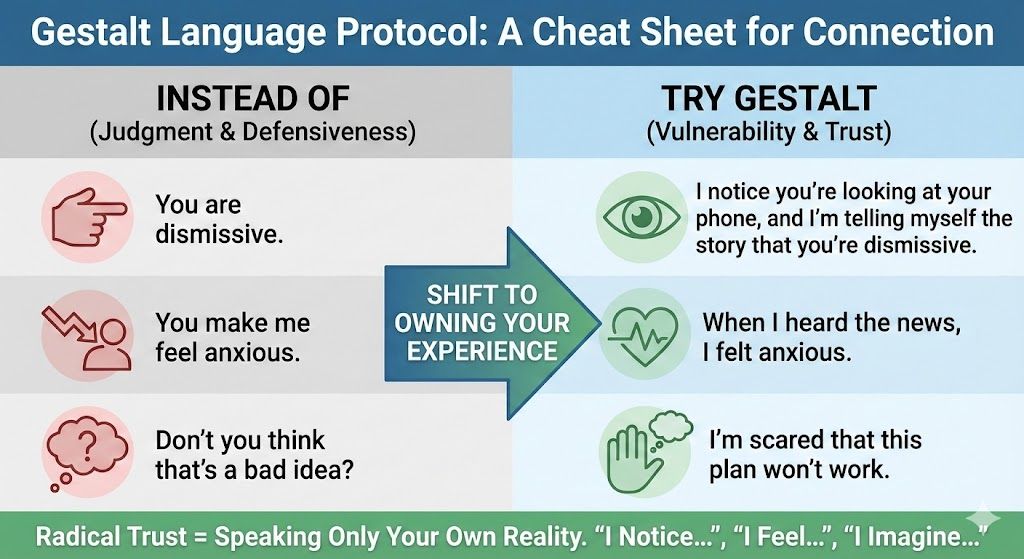
The Trap: Communication Friction
In small or rapidly scaling organizations, "tribal knowledge" often includes unwritten, and often destructive, communication habits. When pressure rises, leaders often default to "You" statements—"You missed the deadline" or "Why are you being defensive?" These are verbal attacks that trigger defensiveness, causing the "Boat" to heel under the weight of conflict.
As I recently learned in a peer advisory group, the Gestalt Language Protocol provides an approach to remove this friction.
BLUF/Summary: To maintain relational stability, strictly own your experience. Speak in the past or present tense about your own perspective to avoid triggering defensiveness in others.
The Protocol: Owning the Helm
This isn't just "soft" skills; it's Enterprise System Design for human interaction. By strictly owning your internal reality, you make it impossible for the other person to be "wrong," fostering a "Total Experience" that values professional respect.
1. From Projecting to Revealing (The "I" Statement)
- Old Way: "You are angry." (Projecting/Guessing).
- Gestalt Way: "I notice your voice is raised, and I’m telling myself the story that you are angry."
- Why it works: You take responsibility for your interpretation. It invites a focus on relationship building rather than firefighting a conflict.
2. Removing the "Victim" Narrative
- Old Way: "You make me feel anxious."
- Gestalt Way: "When I heard that news, I felt anxious."
- Why it works: You stop being a "passive pinball" bounced around by others. You own your emotional "ballast," which is a core trait of an Effective Executive.
3. Opinion Wearing a Question Mark
- Old Way: "Don't you think that was a bad idea?" (Leading Question).
- Gestalt Way: "I’m scared that this plan won’t work."
- Why it works: It clarifies Responsibility and Authority. It forces you to be transparent about your strategic concerns rather than manipulating the conversation.
The Result: A Stabilized Organization When you implement the Gestalt Protocol, you reduce the "ambiguity tax" that slows down decision-making and ensure your senior leaders aren't bottlenecks for work because of avoidable drama.