
Keel Framework
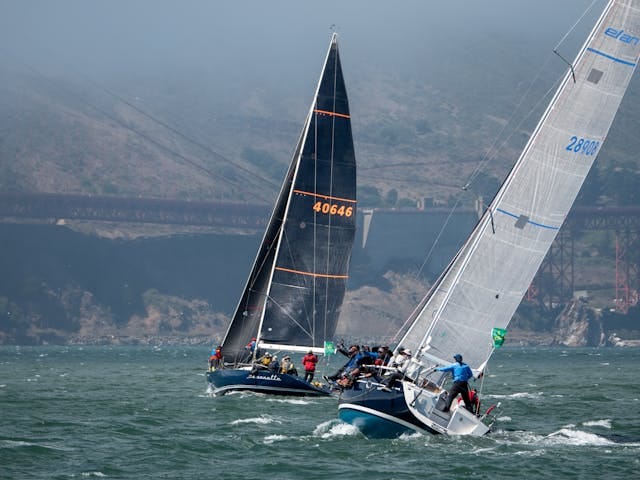
In a market defined by the wind of AI innovation and rapid technological shift, most organizations focus on the wrong thing: speed. They deploy new tools, chase automation, and add capability — more sail — without asking whether their organization can handle the load.
Speed without stability is how boats capsize.
In sailing, the faster the wind blows, the more you depend on the keel — the weighted fin beneath the surface that provides the mass to stay upright and the ability to translate the wind's force into a chosen direction. Without a keel, you drift where the wind blows. With a heavy one, you can navigate a precise course through the strongest storms.
The Keel Framework is a systemic approach to building organizations with enough weight — in their people, processes, structure, and strategy — to carry more sail without tipping over. It's built from two decades of scaling a company from small to 550+ employees, advising dozens of growing organizations, and learning (often the hard way) that the organizations that endure aren't the fastest. They're the most stable.
The Four Elements
The Keel Framework is organized around four elements. They build on each other in sequence — you can't install a keel without a boat, you can't set a course without stability, and you can't catch the wind without a destination. But in practice, mature organizations are strengthening all four simultaneously.
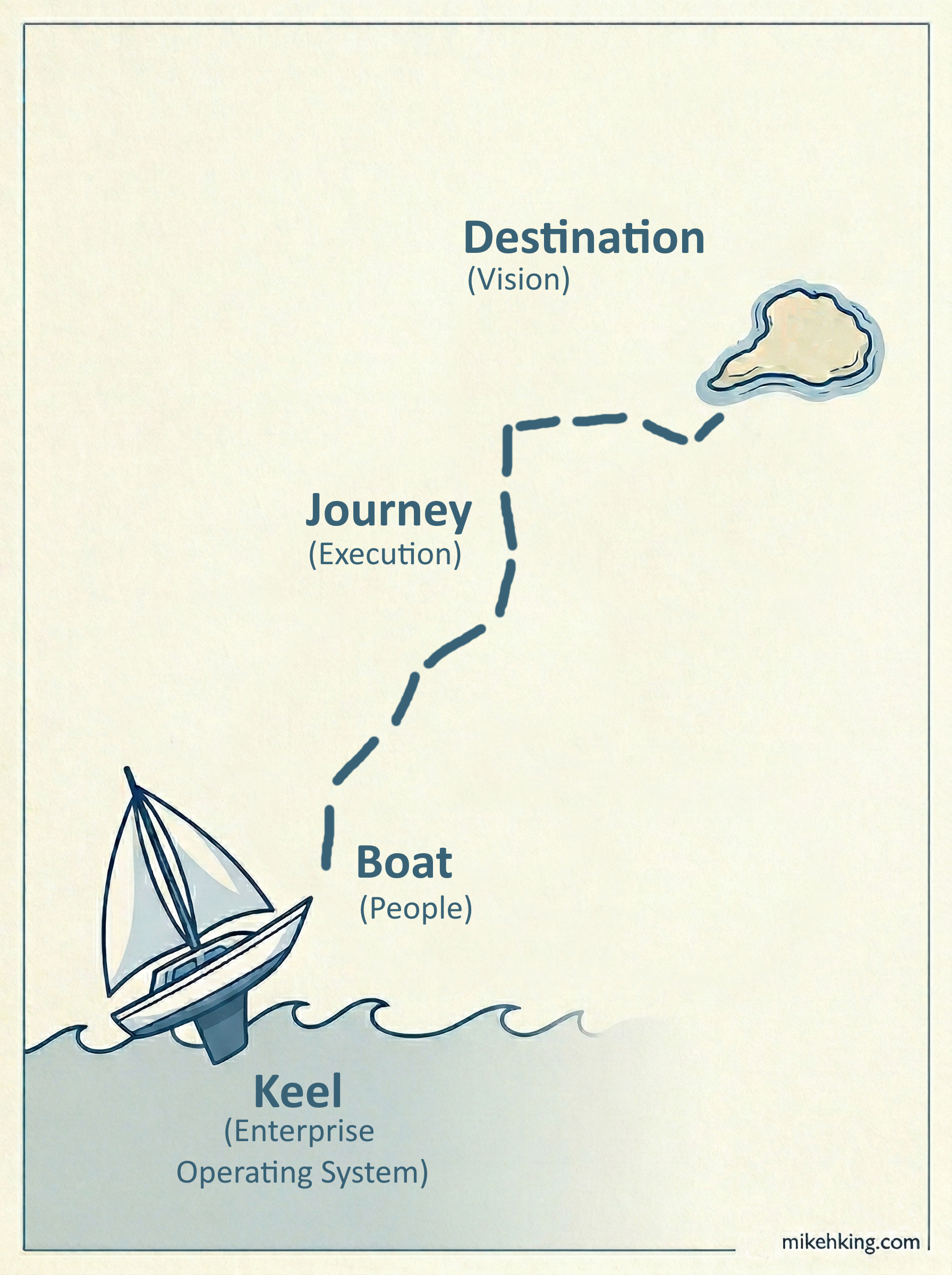
1. The Boat — People
The vessel itself. Before you can optimize a system, the vessel must be sound. The Boat represents the human foundation of your organization — the culture, leadership, and talent that everything else depends on.
Culture as infrastructure. Culture isn't a poster on the wall. It's the operating norms that determine how people behave when no one is watching and when the pressure is on. The strongest organizations I've seen treat culture as something they design and maintain — with explicit principles, documented expectations, and leaders who model the behavior they expect. Culture is the hull of the boat: it determines what the vessel can withstand.
Leadership as system design. Leadership in the Keel Framework isn't about charisma or heroics. It's about designing systems that produce the right behavior at scale. High-agency cultures aren't built by hiring high-agency people and hoping for the best — they're built by creating environments where ownership is the path of least resistance: constrained goals, real accountability rhythms, high standards paired with high autonomy, and incentive structures that reward the behavior you want to see. The leader's job is to build the system, then coach within it.
Talent with intention. Getting the right people on the boat matters — but it matters less than most leaders think if the boat itself is poorly designed. A brilliant crew on a leaky vessel still sinks. The Keel Framework prioritizes designing an organization that makes good people great, rather than relying on great people to compensate for poor systems.
Related reading: High Agency Is Not a Hiring Problem – It's a Systems Problem
2. The Keel — Enterprise Operating System
The weight that stabilizes. This is the heart of the framework and the element most organizations underinvest in. The Keel is your Enterprise Operating System — the documented, maintained, living infrastructure that defines how your organization actually operates. It is the bridge between your people and your performance, and it is what allows you to scale without everything depending on tribal knowledge and individual heroics.
A heavy keel includes:
Roles, responsibilities, and authority. Every person in the organization should be able to answer three questions without asking their boss: What is my job? What decisions can I make? What do I escalate, and to whom? When these answers live in people's heads instead of in a maintained document, you pay an "ambiguity tax" — wasted time, duplicated effort, escalations that didn't need to happen, and decisions that nobody makes because nobody knows who's supposed to. A Roles, Responsibilities, and Authority Matrix (RRAM) eliminates this tax. It's not a bureaucratic exercise. It's the single most clarifying document an organization can build.
Operating cadence. How does strategy flow into execution? Through a cascading rhythm of recurring meetings, each with a defined owner, purpose, frequency, and output. Annual strategy reviews cascade into quarterly planning, which cascades into monthly operational reviews, which cascade into weekly priority check-ins. This "Battle Rhythm" ensures that strategic intent doesn't evaporate between the January offsite and the December review. It's the heartbeat of the organization — and when it stops, the organization drifts.
Knowledge management. The institutional knowledge in your organization is either an asset or a liability, depending on where it lives. If it's in people's heads, it walks out the door every time someone leaves, goes on vacation, or gets promoted. If it's in a maintained knowledge system — welcome pages for new hires, checklist repositories for recurring tasks, runbook catalogs for system maintenance, a knowledge asset matrix tracking what's active and what's retired — it becomes institutional capital. Knowledge management isn't a tool decision. It's a system design decision: how does your organization capture, organize, maintain, and retrieve what it knows?
Documented processes and policies. The way your organization actually works should be written down, accessible, and maintained. Not in PDFs buried in a shared drive — in a living knowledge repository that people use daily. When processes are documented and maintained, you can improve them systematically. When they're not, every improvement is local and temporary, and the organization reinvents the wheel every time someone new takes over a function.
Accountability systems. Accountability isn't a cultural value — it's a mechanism. Weekly priority systems where every team member publishes measurable commitments with action verbs and clear finish lines. Monthly check-ins where leaders report progress against strategic goals. Quarterly reviews where the organization assesses what's working and what isn't. The system creates accountability, so the leader doesn't have to personally enforce it, the rhythm becomes the "bad guy," and the leader becomes the coach.
The Keel is the densest, heaviest part of the framework. It's also the least glamorous. Building an operating manual, maintaining a knowledge base, running a recurring activity matrix — none of this makes headlines. But it's the difference between an organization that can carry sail and one that tips over the moment the wind picks up.
Related reading: Your AI Agents Are Only as Smart as Your Process Assets · Reduce Chaos with an Organizational Playbook
3. The Destination — Vision and Strategy
The chart and the compass. A stable boat with a heavy keel is useless if it's headed toward the rocks — or nowhere at all. The Destination represents the strategic clarity that gives your operational stability a purpose.
Vision as True North. Vision isn't a sentence on a website. It's the answer to the question every employee should be able to give: "Why does this organization exist, and where are we going?" When vision is clear and communicated well, it becomes a decision-making filter at every level. People can ask "does this move us toward our destination?" without waiting for top-down direction. When vision is vague or absent, every decision escalates because nobody has a compass.
Strategic planning as navigation. Strategy is the high-level mapping of how you'll get from where you are to where you want to be. In the Keel Framework, strategic planning isn't a once-a-year event. It's a continuous discipline with its own cadence: analyze the market in the fall, develop the annual strategy in winter, launch it in January with clear communication to every employee, and review progress quarterly. Strategic goals should be few enough that leaders can own them deeply and specific enough that progress can be measured without ambiguity.
The critical connection. The most common failure I see in growing organizations isn't bad strategy — it's the gap between strategy and execution. Leaders set ambitious goals in January and discover in December that nothing happened because the goals were never decomposed into actionable work, assigned to specific people, and tracked through the operating cadence. The Keel Framework addresses this through bidirectional traceability: the ability to trace any piece of tactical work up to the strategic objective it supports, and any strategic objective down to the tasks being completed this sprint. When that traceability exists, strategy isn't a hope. It's a system.
Related reading: Don't Fall into the Planning Trap! · Distill Your Strategy Until It Actually Says Something · Compass vs. Clock
4. Sail and Adjust — Execution
The active navigation. This is where the wind meets the water. Once the boat is sound, the keel is heavy, and the destination is set, you focus on the trim — the constant adjustments required to maintain peak performance and respond to changing conditions.
Multi-scale planning. Long-term strategy is decomposed into annual goals, which are decomposed into quarterly objectives, which are decomposed into sprint-level tasks with clear acceptance criteria and owners. This progressive decomposition is how strategy becomes work — and how work stays connected to strategy. You don't plan everything at the start of the year and hope it survives contact with reality. You plan progressively, with increasing specificity as the execution window approaches.
Execution aligned with The Keel. Daily and weekly work happens within the structure of the Enterprise Operating System. Teams pull prioritized work from groomed backlogs. Leaders operate as product owners, not just delegators — they know the work, validate it, groom it, and prioritize it. Work is visible (in tools like Jira or equivalent), progress is tracked, and velocity trends are monitored so leaders can see problems before they become crises.
Strategy and operational reviews. Formal course corrections happen at defined intervals — quarterly strategy reviews, monthly operational reviews, sprint retrospectives. These aren't status meetings. They're decision-making forums where the organization assesses whether the current heading is still correct and makes adjustments. The operating cadence (from the Enterprise Operating System) provides the structure; the reviews provide the intelligence.
Process improvement, quality, and compliance. The organization continuously improves how it operates through structured feedback loops: internal audits that identify gaps between documented and actual practice, process improvement sessions that surface operational friction, and quality reviews that maintain standards. In compliance-heavy environments (government contracting, healthcare, financial services), these feedback loops serve double duty — they improve operations and generate the evidence that compliance frameworks require. When done well, compliance isn't overhead. It's a byproduct of operational excellence.
Related reading: The AI Automation Trap · Why GovCon Companies That Treat Compliance as a System Win Over Those That Treat It as a Checklist
Why Strategy Must Outpace Innovation
The "AI Automation Trap" occurs when a company tries to add more sail — AI tools, automation, agentic workflows — to a boat with a light keel. The wind of AI innovation is real and powerful. But the organizations that will harness it are the ones that built their operational foundations first.
AI agents can only act on knowledge that's been documented. Automation can only systematize processes that have been defined. Intelligent workflows can only route decisions through authority structures that exist. Every AI capability depends on the organizational infrastructure beneath it. Without a heavy keel, more sail just means a faster capsize.
The Keel Framework ensures your internal systems are weighted and your strategy is clear before you catch the wind of transformation. This is what allows you to move faster, pivot harder, and carry more sail than your competitors — not because you adopted AI sooner, but because your organization was ready for it.
Is Your Keel Weighted Enough?
Every organization is at a different stage of seaworthiness. Some have a great crew but no chart. Others have a fast boat but a keel far too light for the current wind. Some have invested heavily in sail (tools, AI, automation) without realizing the hull is leaking.
The questions that matter:
If a brilliant new hire started tomorrow, could they find a documented explanation of how your organization operates — or would they have to ask around for months? Do your leaders know exactly what they own, what they can decide, and what they must escalate? Does your strategy connect to the work people are doing this week — with real traceability, not just aspirational alignment? Are your processes documented in a place people actually use, or in artifacts that only surface before an audit? If your three most experienced people left tomorrow, would the organization keep running — or would institutional knowledge walk out the door with them?
If any of those questions make you uncomfortable, your keel could use more weight.
The good news: you don't have to build it all at once. Start with the five highest-friction areas — the places where confusion, repeated questions, or tribal knowledge are costing you the most time. Document them. Assign owners. Build them into your operating rhythm. That's how you add weight to the keel, one section at a time.
Subscribe to The Keel to follow the ongoing exploration of these ideas, with practical frameworks and hard-earned lessons from building, scaling, and advising organizations in the AI era.